
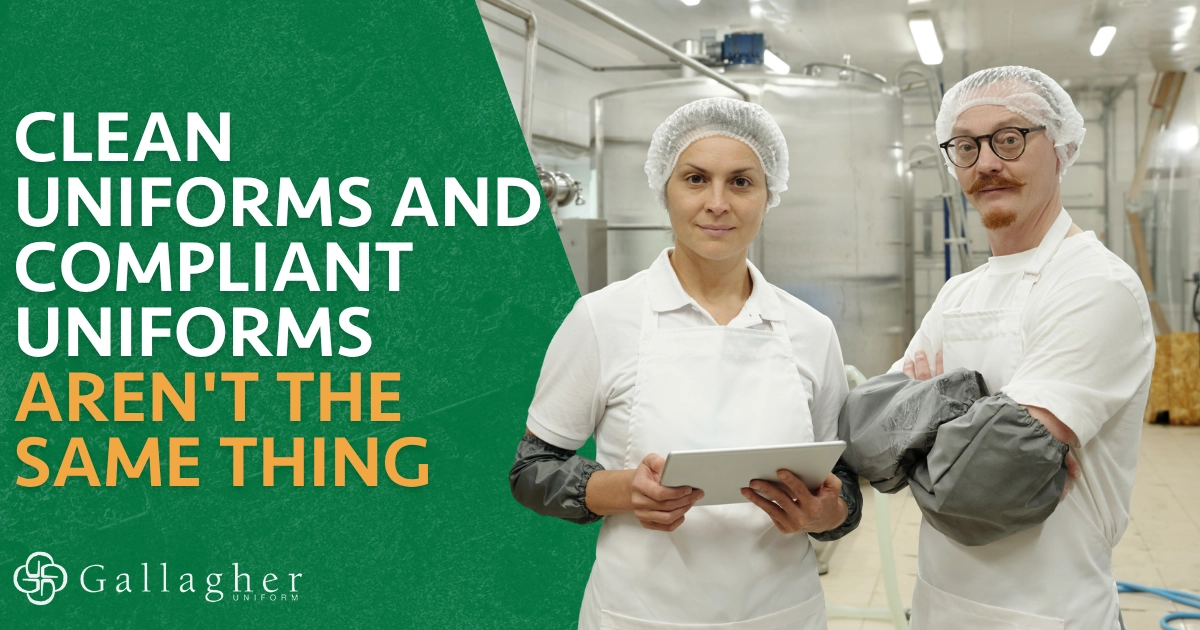
What Food Processors Should Expect From Their Uniform Provider
An auditor asks to see your uniform laundering records. Can you pull them up in thirty seconds, or are you digging through email threads and hoping something matches?
That question is a good gut check for any food processor. It's easy to think of a uniform program as clean shirts showing up on time, and that part matters, but in a food processing environment, your uniform program is a compliance system, a hygiene control, and a piece of your audit trail all at once. It just happens to also keep your team looking sharp.
If you're evaluating your current provider or shopping for a new one, here's what a food processing uniform rental program should actually deliver, not just promise.
Laundering That's Actually Industrial, Not Just "Clean"
There's a real difference between clean and industrially clean, and it matters more in food processing than almost anywhere else.
Home washing machines and lower-tier commercial laundries weren't built to remove the kind of soil, bacteria, and contamination that food production environments introduce. Getting garments truly hygienic takes validated high-temperature wash cycles, controlled chemistry, and a process that's been tested to prove it works, not just assumed to.
Here's what that should look like in practice:
- Wash processes validated to remove contaminants, not just visible dirt
- Clean garments and soiled garments handled through completely separate paths, from pickup through delivery
- A formal inspection before any uniform goes back into rotation
- Damaged garments pulled and replaced instead of quietly sent back out
At Gallagher, every garment moves through our Clean Green Certified facility and a three-point inspection process before it's delivered back to you. If something's not right, it doesn't go back on the truck. That's not a nice-to-have. It's the baseline your provider should be meeting.
Uniform Compliance for Food Processing Plants
Compliance in food processing isn't optional, and it isn't something your uniform provider gets to treat as someone else's problem.
A provider that understands uniform compliance for food processing plants should be building HACCP alignment into your program from day one, not scrambling to explain it after an inspector asks a question. That means garments designed around the realities of your industry:
- No buttons that can fall into product
- No pockets above the waist where contaminants collect
- Closures that hold up to hundreds of industrial wash cycles without breaking down.
Your provider should also understand where FDA and USDA guidance intersects with your daily operations, and be able to talk you through it in plain language, not hand you a binder and walk away.
A TRSA Certified Uniform Service You Can Verify
"Hygienically clean" gets used a lot in this industry. The question is whether your provider can back it up.
TRSA Hygienically Clean Food Safety certification is third-party verified, meaning it's not self-reported. It requires facility inspections and ongoing microbial testing to confirm that laundering processes actually meet the standard, not just claim to. A TRSA certified uniform service should be able to hand you that certification on request. Not talk around it. Hand it to you.
Gallagher holds this certification, along with Clean Green certification for our environmental practices. If your current provider gets vague when you ask for documentation, that's worth paying attention to.
Employee Hygiene Practices Built Into the Program
Good hygiene doesn't stop at the laundry. It has to carry through how garments are issued, stored, and returned every single day.
Facilities with strong hygiene practices typically use zone-based garment separation, sometimes color-coded, so it's immediately clear if someone from a low-care area wanders into a high-care zone wearing the wrong uniform. Clean garments need a controlled, protected issue point. Soiled garments need a clearly marked return location that never gets mixed up with clean stock. And employees shouldn't be borrowing a coworker's spare uniform because their own wasn't ready. That kind of informal workaround is exactly how hygiene protocols quietly break down.
A provider worth working with helps you design that structure, not just drop off garments and leave the logistics to you.
Traceability From Wash to Wearer
If you can't answer "where has this garment been," you have a gap, whether or not anyone's noticed it yet.
This is where garment-level tracking earns its place in a food processing uniform program. Our G-Trak system uses RFID technology to follow every garment through the entire rental cycle, wash, repair, delivery, and back again. That means you can see which employee has which uniform, when it was last laundered, and when it's due back, without relying on memory or a clipboard.
For food processors specifically, that kind of traceability does double duty. It supports the separation between high-care and low-care areas, and it gives you a real answer the next time someone asks how you know your garments are where they're supposed to be.
Audit Readiness: Documentation You're Not Scrambling to Find
Compliance isn't just about doing things right. It's about being able to prove it, on demand, without a scramble.
Food safety audits, whether they're internal, regulatory, or tied to a GFSI-recognized scheme, expect documented controls around uniform handling. That includes proof of certification, records of laundering frequency, and evidence that garments are tracked and inspected consistently. When that documentation lives in a system instead of someone's inbox, an audit stops being a fire drill.
The difference comes down to this: "we believe our uniforms are compliant" versus "here's the documentation that proves it." Only one of those holds up when someone's actually checking.
Questions to Ask When Choosing a Uniform Company for Food Manufacturers
Whether you're evaluating your current provider or choosing a uniform company for food manufacturers for the first time, these are the questions worth asking directly:
- Can you show me your TRSA Hygienically Clean certification, not just describe it?
- How do you physically separate high-care and low-care garments?
- What does garment-level tracking look like, and can I see the data myself?
- What's your inspection process before a uniform goes back into rotation?
- If an auditor walked in tomorrow, what documentation would you have ready?
- Who's my point of contact, and does that person actually stay consistent?
If the answers are vague, or if you're getting routed to a call center instead of a real person, that's a preview of what your day-to-day service will feel like. Pay attention to it now, before you sign anything.
Everything You Should Expect, From One Partner
Professional laundering, HACCP-aligned compliance, TRSA Hygienically Clean certification, RFID traceability, and audit-ready documentation shouldn't come from five different vendors, or worse, be missing entirely.
At Gallagher Uniform, they come from one partner, backed by five generations of family ownership and G-Trak technology built for food processing environments. You shouldn't have to wonder whether your program could hold up to an audit tomorrow. You should know it can.
 SafeUnsubscribe® link, found at the bottom of every email.